- A
- A
- A
- АБB
- АБB
- АБB
- А
- А
- А
- А
- А
109028, Москва, Покровский бульвар 11, T423
тел: +7 (495) 621 13 42,
+ 7(495) 772 95 90 *27200; *27212.
e-mail: dhm-econ@hse.ru; shatskaya@hse.ru.



Совместная программа по экономике НИУ ВШЭ и РЭШ
55 бюджетных мест
20 платных мест
Экономика
110 бюджетных мест
40 государственных стипендий Правительства РФ для иностранцев
90 платных мест
5 платных мест для иностранцев
Экономика и анализ данных
30 бюджетных мест
10 государственных стипендий Правительства РФ для иностранцев
30 платных мест
3 платных места для иностранцев
Экономика и статистика
35 бюджетных мест
15 государственных стипендий Правительства РФ для иностранцев
50 платных мест
3 платных места для иностранцев
Экономический анализ
Онлайн-программа
20 платных мест
3 платных места для иностранцев
Аграрная экономика
Инвестиции на финансовых рынках
Онлайн-программа
40 платных мест
3 платных места для иностранцев
Корпоративные финансы
50 платных мест
1 платное место для иностранцев
Магистр аналитики бизнеса
Онлайн-программа
50 платных мест
3 платных места для иностранцев
Статистический анализ в экономике
20 бюджетных мест
10 государственных стипендий Правительства РФ для иностранцев
5 платных мест
2 платных места для иностранцев
Стохастическое моделирование в экономике и финансах
20 бюджетных мест
10 государственных стипендий Правительства РФ для иностранцев
5 платных мест
1 платное место для иностранцев
Стратегическое управление финансами фирмы
40 бюджетных мест
10 государственных стипендий Правительства РФ для иностранцев
10 платных мест
2 платных места для иностранцев
Финансовые рынки и финансовые институты
45 бюджетных мест
10 государственных стипендий Правительства РФ для иностранцев
5 платных мест
2 платных места для иностранцев
Финансовый инжиниринг
40 платных мест
2 платных места для иностранцев
Экономика и экономическая политика
65 бюджетных мест
20 государственных стипендий Правительства РФ для иностранцев
20 платных мест
1 платное место для иностранцев
Экономический анализ
Онлайн-программа
60 платных мест
5 платных мест для иностранцев

Состоялось очередное заседание общемосковского научного семинара "Математические методы анализа решений в экономике, бизнесе и политике"
Тема: Minorities and Efficient Referanda Mechanisms
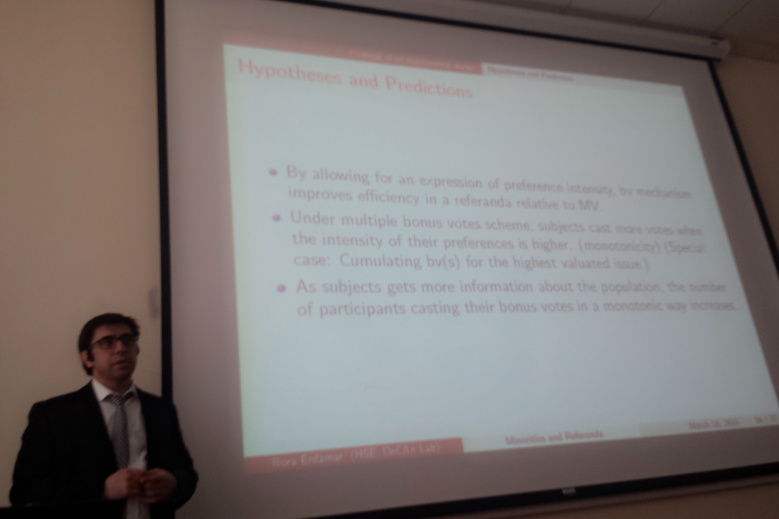
Аннотация
Systematic misrepresentation of minorities is among the fundamental problems of democracies, which is usually the source of many social conflicts in societies and also source of inefficiency in terms of (utilitarian) welfare measures. Majoritarian rules -despite their simplicity and some desirable properties- are not sensitive to any intensity of preferences, hence not capable to cure this problem. Availability and increased usage of online platforms where users can express their opinions in more flexible ways signal that (i) Direct democracy tools can be used widely in near future for referanda and elections. (ii) Design of new voting mechanisms is needed to resolve the misrepresentation problem and by this way, aggregate welfare gains can also be established. Recent literature provides some promising examples of these new rules. In this survey, we examine these rules theoretically with a particular emphasis on Storable Votes and we test their performance in a field experiment.