• A
  • A
  • A
  • ABC
  • ABC
  • ABC
  • А
  • А
  • А
  • А
  • А
Regular version of the site

Tag "Department of Mathematics"

HSE Seminar on Political Economy: Kemal Kivanc Akoz (HSE) about the preemptive and counter offers in games theory

Kemal Kivanc Akoz (HSE) examined usage of preemptive and counter offers in multiagent games with full and partial information.

HSE Seminar on Political Economy: Eugenia Chernina (HSE) about actual and perceived place in the income distribution

Eugenia Chernina (HSE) explored how far individuals’ perceptions deviate from the true level of inequality and what factors shape the divergence.

HSE Seminar on Political Economy: Gari Walkowitz (Technical University of Munich, Center Digitization.Bavaria) about the Economic Consequences of Moral Hypocrisy

Gari Walkowitz discussed the effectiveness of (apparently) fair procedures - which are under the full control of the agent in situations which entail a conflict of interest and when social pressures to conform are high - and analyzed a specific form of inter-personal deception: moral hypocrisy, i.e., saying one thing (trying to appear moral to others) but doing another (act immorally).

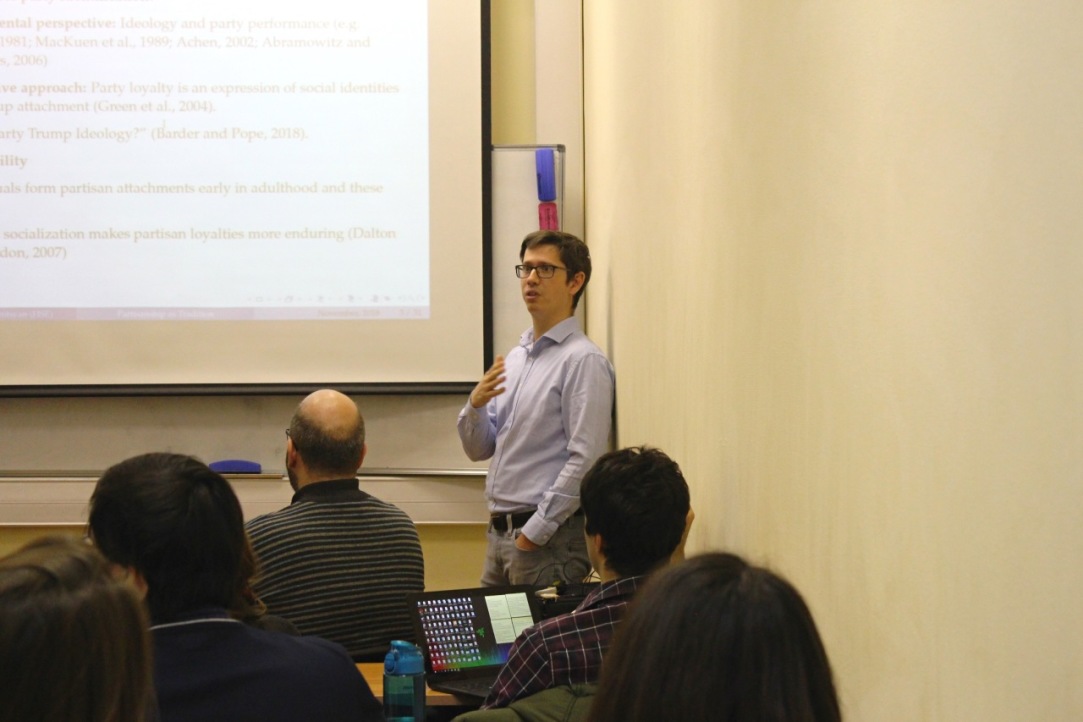
HSE Seminar on Political Economy: Eren Arbatli (HSE) about the Collective Memory and Persistent Party Identification

HSE Seminar on Political Economy: Eren Arbatli (HSE) about the Collective Memory and Persistent Party Identification
Can party loyalty be motivated by social and cultural identities transmitted across generations and collective memory? Eren Arbatli says "yes", analyzing the history of Sasun, a mountainous region of the Ottoman Empire located in Eastern Turkey.

HSE Seminar on Political Economy: Ethan Bueno de Mesquita (University of Chicago) about cyberwarfare models

Ethan Bueno de Mesquita studied deterrence in a world where attacks cannot be perfectly attributed to attackers. In his model, each of n attackers may attack the defender. The defender observes an imperfect signal that probabilistically attributes the attack. The defender may retaliate against one or more attackers, and wants to retaliate against the guilty attacker only. He uncover an endogenous strategic complementarity among the attackers: if one attacker becomes more aggressive, that attacker becomes more “suspect” and the other attackers become less suspect, which leads the other attackers to become more aggressive as well. 

HSE Seminar on Political Economy: Chris Berry (University of Chicago) about Leader Effects

Chris Berry explained the quantitative test of leader effects (RIFLE), that allows researchers to test a null hypothesis of no leader effect and also estimate the proportion of variation in an outcome variable attributable to leaders vs. other factors. To demonstrate the substantive value of RIFLE, he implemented it for world leaders, U.S. governors, and U.S. mayors and for several outcomes. This results improve understanding of where, when, and why leaders matter.